Rethinking Computerized Maintenance Management Systems inLMICs
Keywords:
Computerized Maintenance Management Systems (CMMS), Low- and Middle- Income Countries (LMICs), Artificial Intelligence (AI), Data Graveyards, Health Technology ManagementAbstract
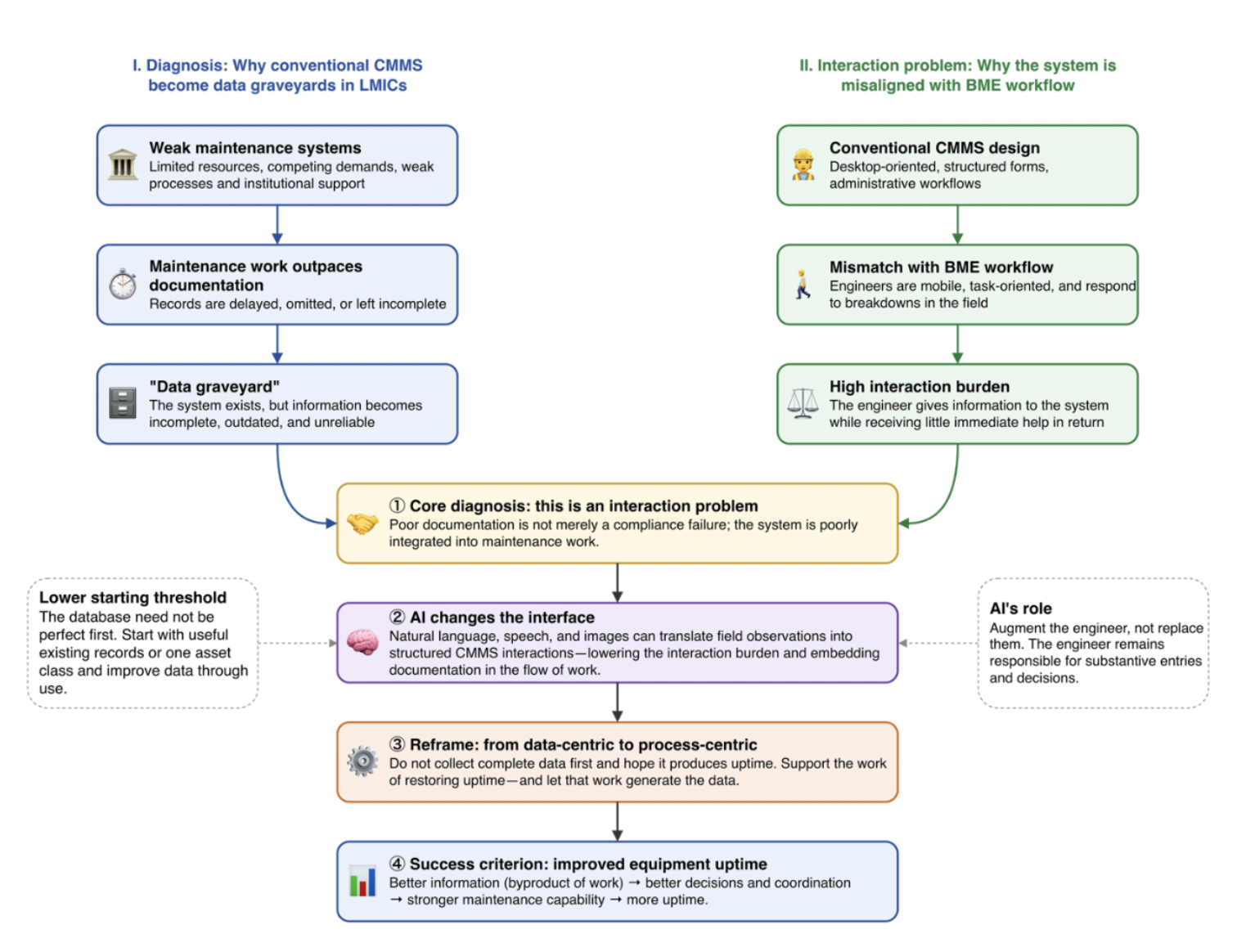
Global health efforts to address medical "equipment graveyards" in low- and middle-income countries (LMICs) have spurred investments in computerized maintenance management systems (CMMS). However, because high-friction desktop workflows clash with the mobile reality of frontline engineers, these platforms can deteriorate into outdated "data graveyards."
This article proposes that artificial intelligence (AI) can address this user interface bottleneck by serving as a multimodal, conversational intermediary. Not by replacing technicians or acting primarily as a diagnostic tool, large language models can help to translate unstructured field observations (voice, text, or images) into structured maintenance records. Beyond simply reducing the documentation burden, these AI models can act as active agents—instantly retrieving asset histories, synthesizing repair data, and providing real-time decision support for equipment maintenance or decommissioning. This paradigm allows LMICs to leapfrog legacy desktop architectures in favor of mobile, user-centric systems where data capture and knowledge retrieval become a natural byproduct of maintenance work.
While AI presents a significant opportunity to amplify human capacity, realizing its potential requires addressing infrastructure gaps, language barriers, and data governance. Crucially, mitigating the risks of AI hallucinations necessitates human-in-the-loop validation, ensuring that AI acts as an administrative and analytical assistant while biomedical engineers retain ultimate professional responsibility.
Downloads
Published
Issue
Section
License
Copyright (c) 2026 Christian Neumann, Gerry Douglas (Author)

This work is licensed under a Creative Commons Attribution 4.0 International License.